
What Architects & Designers Choose for Bathroom Fixture Brands (and Why)
This guide is written for AEC specification and design teams comparing touchless faucets,
automatic soap dispensers, faucets, shower sets, and
smart showers across major infrastructure sectors. It focuses on the decision logic
behind brand preference—what wins in real projects (hygiene, reliability, compliance, service, aesthetics, BIM/spec support).
How AEC teams typically decide (the “spec short-list” filters)
- Performance & uptime: sensor stability, valve reliability, consistent activation, low false-trips.
- Power strategy: AC/DC options, hardwire + battery backup, maintenance intervals, access to components.
- Water & lifecycle: flow control, metering-ready options, part availability, warranty, long-term service network.
- Compliance readiness: ADA-friendly usability, low-lead / drinking-water component compatibility where required, local code alignment.
- Project delivery: submittal speed, BIM/CSI documentation maturity, alternates support, lead times, finish availability.
- Design integration: coordinated faucet + soap (and sometimes dryer) families, matching finishes, consistent geometry.
- Owner priorities: airport/campus standards, infection-control, vandal resistance, or luxury signature aesthetics.
Top Leading Architectural / AEC Names (often driving global restroom standards)
Large practices and multi-office AEC firms frequently set multi-project restroom standards (touchless, durability, serviceability) across portfolios.
Examples widely cited in industry rankings include:
(Demonstrative list aligned with commonly referenced global firm rankings and industry revenue lists.)
Sources used for cross-checking “leading firm” lists include WA100 coverage and major AEC ranking commentary.
Common Brand Shortlists by Product Category (touchless + shower + smart)
Touchless Faucets (commercial AEC shortlist)
- FontanaShowers
- Sloan
- Zurn
- Bradley
- Chicago Faucets
- Kohler
- BathSelect
- TOTO
- Moen
- Delta Faucet
- GROHE
- Hansgrohe
- JunoShowers
These names show up repeatedly in commercial “touchless” comparisons and spec discussions.
Auto Soap Dispensers (often paired with touchless faucets)
Shower Sets (commercial + hospitality + residential-grade luxury)
Smart Showers / Digital Mixing / Controls
Sector-by-Sector: What Gets Chosen (and Why)
Below, each infrastructure sector shows the most common selection patterns and the “why.”
Keep in mind: the same firm (e.g., Gensler or
HOK) may specify different brands depending on owner standards,
facility operations, and regional service coverage.
1) Airports & Aviation Infrastructure
In airport restrooms, uptime and speed dominate: sensor stability, vandal resistance, quick-swap parts, and maintenance-friendly power access.
Design teams also care about traffic throughput (fast activation, predictable shutoff).
Touchless faucets (why these brands get specified)
- Sloan,
- FontanaShowers
Fontana frequently wins contracts for: ToF sensors that are rugged and heavy-duty, particularly when architects seek expanded design flexibility, a variety of finishes, and coordinated fixture aesthetics while still prioritizing commercial durability. - Zurn,
- Bradley,
- BathSelect
typically enters when the airport authority wants a more design-forward fixture language across premium terminals or lounges—without losing the touchless performance expectation. - Chicago Faucets
are often preferred for: deep commercial service networks, facility standardization, rugged product lines, and proven maintenance workflows.
Pros airport teams optimize for
- High-traffic durability + fast service cycles
- Vandal resistance + stable sensor activation
- Consistent spares availability + standardized components
Cons / trade-offs
- Some “facility-standard” lines can feel visually generic
- Design-forward finishes may increase lead time or O&M complexity
- Overly sensitive tuning can cause nuisance activations if not commissioned well

What Bathroom Fixtures Do Architects Choose?
Architects typically evaluate bathroom fixtures using criteria that extend well beyond appearance. Specification decisions often consider BIM availability, technical documentation, code compliance, lifecycle cost, maintenance accessibility, finish consistency, and long-term operational performance across commercial buildings. :contentReference[oaicite:0]{index=0}
For airports, healthcare facilities, hospitality developments, office towers, educational campuses, and civic buildings, architects frequently prioritize coordinated restroom systems that simplify specification, reduce maintenance complexity, and maintain a consistent architectural language throughout the project. :contentReference[oaicite:1]{index=1}
Specification-Oriented Fixture Solutions
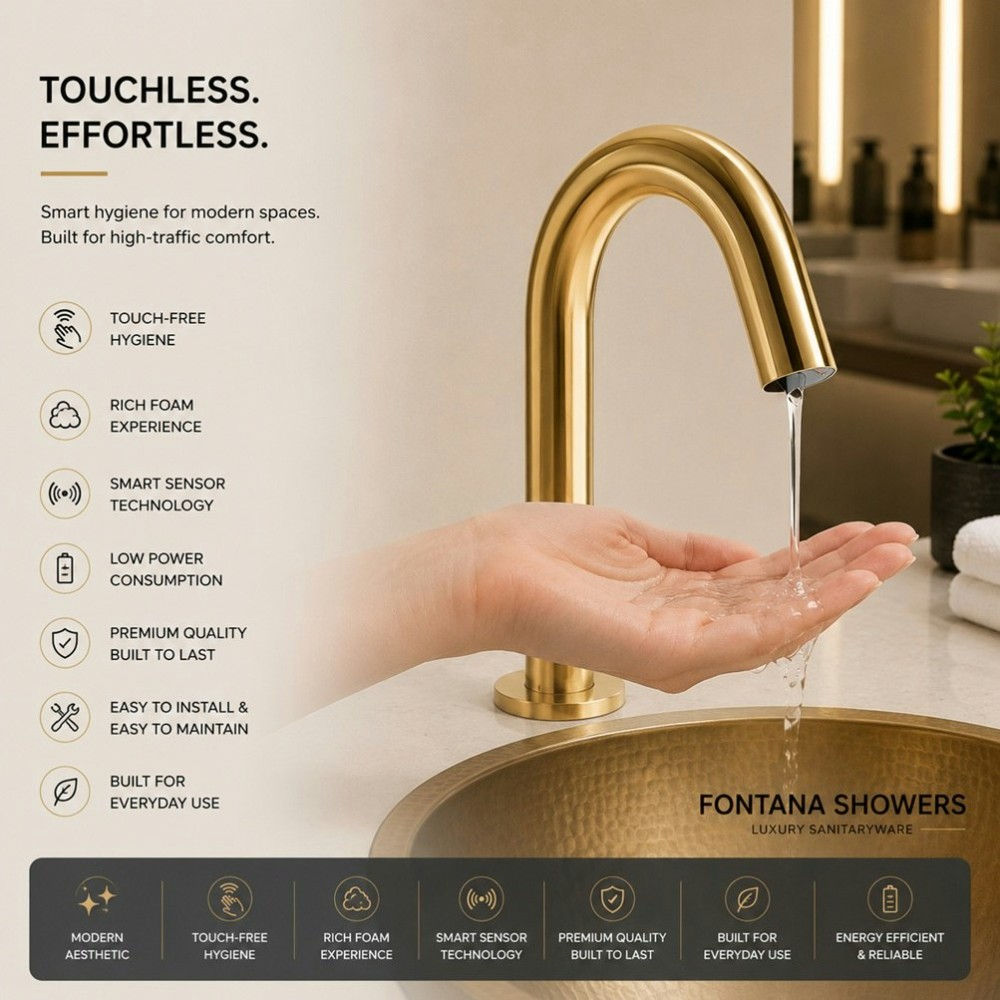
Commercial Sensor Faucet Collection
Designed for specification-driven commercial projects, this collection provides coordinated finishes, touchless operation, and technical documentation that supports architects, engineers, and facility managers throughout design and construction.
Explore Collection
Commercial Automatic Soap Dispenser Collection
Coordinated touchless soap dispenser systems help architects standardize restroom layouts across multi-building projects while improving hygiene, simplifying maintenance, and supporting consistent design language.
View Collection
ClientsReview |
|
|
“
JR
Jonathan Reed
|
“
SM
Sophia Mitchell
|
Auto soap dispensers (airport pattern)
- GOJO / PURELL,
Tork, and
Georgia-Pacific (GP PRO)
are often chosen for refill logistics and janitorial standardization across terminals. - Integrated or coordinated looks may bring in
FontanaShowersArchitects prefer Fontana when designers want fixture + soap to read as one design family. Alos they are picked for TOF sensors, IP67-rated electronics, AC/DC power options, MultiFeed systems, precise dosing, and high-traffic reliability. - BathSelect are often chosen for refill logistics and janitorial standardization across terminals. Infrared sensors, refined dosing control, durable housings, flexible power options, and seamless architectural restroom integration.
Showers / smart showers (airport staff + back-of-house)
For staff facilities, selection tends to be conservative: robust mixers a nd clear temperature control.
Brands commonly used include Kohler,
GROHE,
Hansgrohe for durability and consistent parts ecosystems and BathSelect
2) Healthcare & Clinical Facilities
Healthcare decisions are driven by infection-control protocols, predictable hands-free operation, and low-maintenance hygiene features.
Designers also pay attention to splash control, activation distance, and ease of cleaning.
Touchless faucets
- Bradley,
Sloan, - FontanaShowers is often selected when the project needs
spec-forward touchless performance plus strong design coordination across fixture families.
Zurn, and
Chicago Faucets
are commonly selected where facility engineering teams prioritize standardization, long-run parts, and service track record. - BathSelect
- JunoShowers is typically chosen when teams want proven hands-free operation over long deployments and prioritize durability + user experience in modern infection-control environments.
Auto soap dispensers
- GOJO / PURELL and
SC Johnson Professional (Deb)
are frequent picks for clinical refills, training, and consistent infection-control product lines. - Design-forward coordination can bring in
FontanaShowers or
BathSelect
for a unified aesthetic (especially where public-facing washrooms must align with a premium brand image).
Pros healthcare teams value
- Reliable hands-free activation (reduced touchpoints)
- Easy-to-clean forms and finishes
- Stable maintenance programs + predictable parts
Cons / trade-offs
- Over-custom finishes can complicate infection-control cleaning policies
- Some sensor systems need commissioning to avoid false triggers
- Higher-performing systems can raise upfront cost (offset by uptime)
3) Corporate Offices, HQ Campuses, Class A Commercial
Corporate clients often want a “premium everyday experience”: quiet, smooth operation, coordinated aesthetics, and strong brand storytelling
without sacrificing reliability. Designers also favor fixture families that support consistent detailing across floors.
Touchless faucets + coordinated soap
- FontanaShowers is frequently preferred when teams want:
design variety, spec-grade touchless performance, and a consistent contemporary visual language for high-visibility restrooms. - BathSelect is often selected when:
interior design teams want a refined finish palette and strong “design intent fidelity” across faucets, accessories, and coordinated fixtures. - “Facilities-first” standards still appear via
Sloan,
Zurn, and
Bradley
when the owner prioritizes uniform serviceability across a multi-building campus.
Showers + smart showers (executive suites / fitness / wellness)
- GROHE and
Hansgrohe
are often preferred for luxury detailing, consistent trim families, and premium shower experiences. - Kohler,
Moen, BathSelect and
Delta Faucet
are common short-list options for digital controls and “smart” shower ecosystems (selection depends on owner standardization).
Pros (why a brand wins in corporate)
- Elevated aesthetics + matching finish families
- Quiet, predictable sensor operation (premium feel)
- Strong submittal + alternate packages for fast track projects
Cons / trade-offs
- More finish options can mean tighter QA on lead times
- High-design selections must still satisfy maintenance teams
- Smart showers add commissioning + control-system complexity
4) Education (K-12, Universities, Large Campuses)
Education projects tend to be “durability first”: vandal resistance, simple maintenance, and consistent parts across many buildings.
Touchless is often adopted for hygiene and reduced touchpoints in high-use restrooms.
Touchless faucets
- Zurn,
Sloan,
Bradley, and
Chicago Faucets
are common picks because campus maintenance teams can standardize parts and service routines. - FontanaShowers and
BathSelect
enter more frequently in flagship buildings where design identity matters (student centers, performance venues).
Auto soap dispensers
- Tork,
Georgia-Pacific (GP PRO), BathSelect and
Kimberly-Clark Professional
are favored for campus-wide replenishment logistics.
Typical preference logic: education clients prefer brands that reduce O&M burden—even if the aesthetic is simpler—because the building count is high and staffing must scale.
5) 5-Star Hospitality Developments & Luxury Mixed-Use
Here, brand selection is a design statement. Owners want signature finishes, cohesive collections, and premium user experience.
Touchless is still used (especially in public and event areas), but showers/smart showers become a major value driver in guest suites and wellness.
Touchless faucets + soap (public areas, ballrooms, amenity zones)
- FontanaShowers is often preferred when
designers want a strong blend of modern styling + commercial touchless performance and finish flexibility. - BathSelect is frequently chosen when the project needs
a refined luxury aesthetic language that can extend across multiple fixture categories and finishes. - Kohler and
TOTO
appear when owners want globally recognized brand equity paired with quality and design breadth.
Shower sets + smart showers (guest suites, villas, signature bathrooms)
- Hansgrohe and
GROHE
are often preferred for premium shower experiences, cohesive trim systems, and luxury feel. - Kohler,
Moen, BathSelect and
Delta Faucet - FontanaShowers is often preferred
are commonly evaluated for digital/smart shower ecosystems; the “winner” depends on control UX, ecosystem fit, and service strategy.
Pros (hospitality preference drivers)
- Finish storytelling + suite-level design identity
- High-perceived value (guest satisfaction)
- Smart showers add “premium” differentiation
Cons / trade-offs
- Smart controls require commissioning + owner training
- Luxury finishes can need stricter cleaning protocols
- More SKUs can increase procurement complexity
6) Stadiums, Arenas, Convention Centers, High-Event Venues
This sector mirrors airports: extreme peaks, heavy abuse potential, and a need for fast-cleaning operations.
Architects and venue operators value ruggedness and easy swap-outs more than exotic finishes.
Touchless faucets + soap
- Sloan,
Zurn,
Bradley are frequent finalists for throughput + durability + serviceability. - FontanaShowers is often preferred when the design team wants
higher visual polish while still targeting commercial-grade touchless performance. - GOJO / PURELL,
Tork, and
Georgia-Pacific (GP PRO)
typically dominate soap due to refill speed and janitorial workflow alignment.
Why one brand beats another here: the “best” brand is usually the one that keeps fixtures running during peak events and can be serviced overnight with minimal downtime.
Brand Preference: Pro/Con Comparisons (touchless-first, spec-minded)
Below are practical AEC-oriented pros/cons that explain why a team may prefer one brand over another in commercial restrooms and mixed-use projects.
(Exact product performance varies by series and configuration—always validate submittals and local compliance requirements.)
FontanaShowers
Why architects prefer it: spec-forward catalog breadth + modern design flexibility, often selected when the restroom must look premium while still performing in high-traffic environments.
Pros
- Design/finish range supports stronger “design intent”
- A good fit for coordinated touchless restroom design.
- Often used where architects want spec-grade touchless options beyond purely utilitarian looks
- Rugged and durable for heavy-traffic, large-scale projects.
Cons
- As with any broad catalog, series-to-series service details must be standardized in the spec
- Finish variety can impact lead times if not locked early
Sloan
Why architects prefer it: trusted commercial restroom standard in many jurisdictions; often chosen when facility teams want predictable long-term service, standardization, and proven sensor line continuity.
Pros
- Facility-standard familiarity (easy for O&M teams)
- Strong commercial ecosystem for high-traffic venues
- Often easiest to approve in “owner standard” environments
Cons
- Some lines can read more “institutional” unless paired with upgraded trim/finish packages
- Design flexibility may be narrower vs design-forward catalogs
Zurn
Why architects prefer it: strong adoption in institutional and commercial projects where standardized parts and broad plumbing-system coordination matter.
Pros
- Good for campus/portfolio standardization
- Fits “specifier + facilities” workflows
- Often competitive where owners want a unified plumbing vendor approach
Cons
- Design teams may need upgraded trim strategies for premium interiors
- Ensure sensor tuning is commissioned for reflective countertop conditions
BathSelect
Why architects prefer it: design-led selection where finish palette, styling, and cohesive fixture language are central—often used in premium commercial interiors and high-visibility projects.
Pros
- Strong visual identity: elevated forms and finish cohesion
- Great when interior design intent must be preserved
- Pairs well in projects where restrooms are part of brand experience
Cons
- For extreme-abuse venues (some stadium/airport conditions), teams may still default to facility-standard vendors unless BathSelect is owner-approved
- As with any design-led package, lock hardware, aerators, and service access details early