
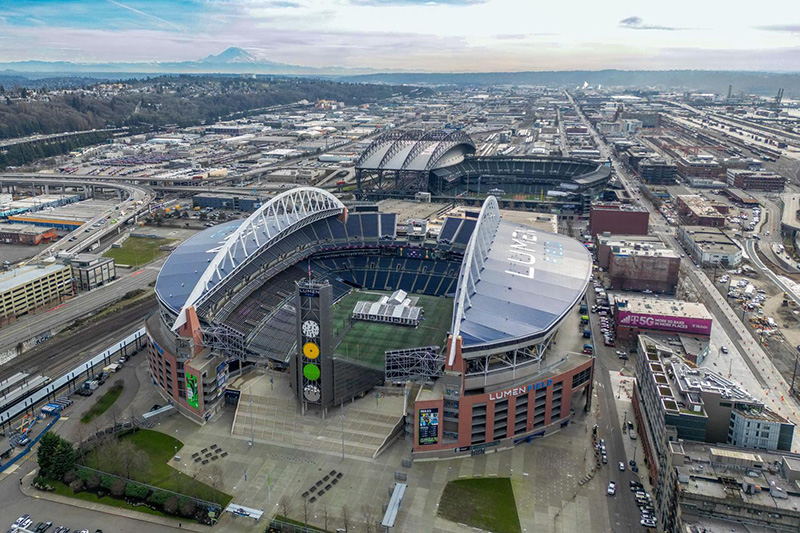
 Lumen Field — Seattle
Flow-Rate Compliance Requirements in Commercial Restroom Engineering
Flow-rate compliance in commercial restroom engineering requires more than specifying a low gallons-per-minute value. Architects, plumbing engineers, contractors, specification writers and facility teams must coordinate the faucet classification, outlet device, water pressure, basin geometry, sensor operation, power supply, accessibility, certification requirements and long-term service strategy.
In stadiums, arenas, theaters, transportation facilities and other high-occupancy buildings, those requirements become particularly important because hundreds of handwashing fixtures can experience concentrated demand during short periods. Properly configured touchless faucets can support regulatory approval while maintaining a predictable handwashing stream, rapid activation and reliable operational performance.
Flow-Rate Compliance Starts With the Correct Fixture Classification
Commercial restroom design should begin by identifying whether the faucet serves a public or private lavatory and whether the fitting operates as a metering or nonmetering device. Under commonly adopted plumbing-code provisions, a public lavatory faucet other than a metering faucet is generally limited to a maximum of 0.5 gallons per minute at the applicable reference pressure. Metering faucets are evaluated by the quantity of water delivered during each cycle.
Electronic activation does not automatically make a faucet a metering fitting. A sensor-operated faucet may remain open while the user’s hands occupy the detection zone and close when they are removed. The project team should therefore review the manufacturer’s exact operational description together with the definitions contained in the locally adopted plumbing code.
| Engineering Item | Typical Requirement | AEC Coordination |
|---|---|---|
| Public nonmetering lavatory | Commonly 0.5 GPM maximum | State the maximum directly in the fixture schedule. |
| Public metering faucet | Controlled by volume per cycle | Confirm the submitted faucet actually meets the code definition. |
| Outlet device | Aerator or flow-control insert | Identify the exact approved component in the submittal. |
| Operating pressure | Manufacturer-defined range | Confirm dynamic conditions at hydraulically remote restroom banks. |
| Local amendments | Project specific | Verify adopted plumbing and green-building provisions. |
Stadium Plumbing Systems Experience Concentrated Demand

Caesars Superdome — New Orleans
Large stadiums illustrate why fixture flow cannot be evaluated independently from building demand. Restroom banks may experience simultaneous use before events, at intermission or halftime, and during post-event egress.
The domestic-water distribution system must preserve acceptable residual pressure while supplying many fixtures over a short period. The design should coordinate branch sizing, pressure loss, fixture-unit calculations, temperature control and flow-limiting outlets.
Stadium Image SourceA 0.5 GPM faucet can provide good handwashing performance when outlet design, supply pressure, spout geometry and the basin are coordinated. Conversely, the correct nominal GPM alone does not ensure a successful installation. Poor pressure conditions, an incompatible aerator, excessive spout height or an incorrectly positioned sensing zone can create a weak stream, splash or repeated user activations.
Fixture Flow and Water Distribution Must Be Engineered Together
Dynamic Pressure
Verify pressure while multiple restroom fixtures are operating. Static pressure measured when the building is idle does not describe conditions during a stadium demand surge.
Branch Distribution
Pipe sizing, elevation, pressure regulation, friction loss and the number of simultaneously operating faucets affect the available flow at the most remote station.
Outlet Control
The installed aerator or flow-control insert should correspond exactly with the component reviewed during the product-submittal process.
Occupancy Scale Magnifies Small Fixture Decisions
In a very large sports venue, seemingly minor operating differences can become measurable building-wide effects. A few additional seconds of unnecessary faucet runtime, a higher replacement aerator or repeated nuisance sensor activations can be multiplied across hundreds of stations and thousands of daily users.
Engineers should therefore evaluate water efficiency as a system characteristic rather than treating it as a single catalog value. Fixture flow, activation duration, supply pressure and maintenance practice all contribute to actual consumption.
Touchless Control Adds Time as a Water-Efficiency Variable
Manual faucets are primarily controlled through outlet flow and user operation. Touchless faucets add sensing and automatic shutoff to the equation. A properly commissioned fixture activates when hands enter the intended detection zone and closes soon after the user leaves.
This can help limit unnecessary runtime, but only when detection is stable. False activations, excessive shutoff delay, poor sensor placement or repeated re-triggering can reduce the intended efficiency benefit. For large public projects, engineers should therefore review sensing distance, response time, maximum runtime, power supply and environmental conditions.
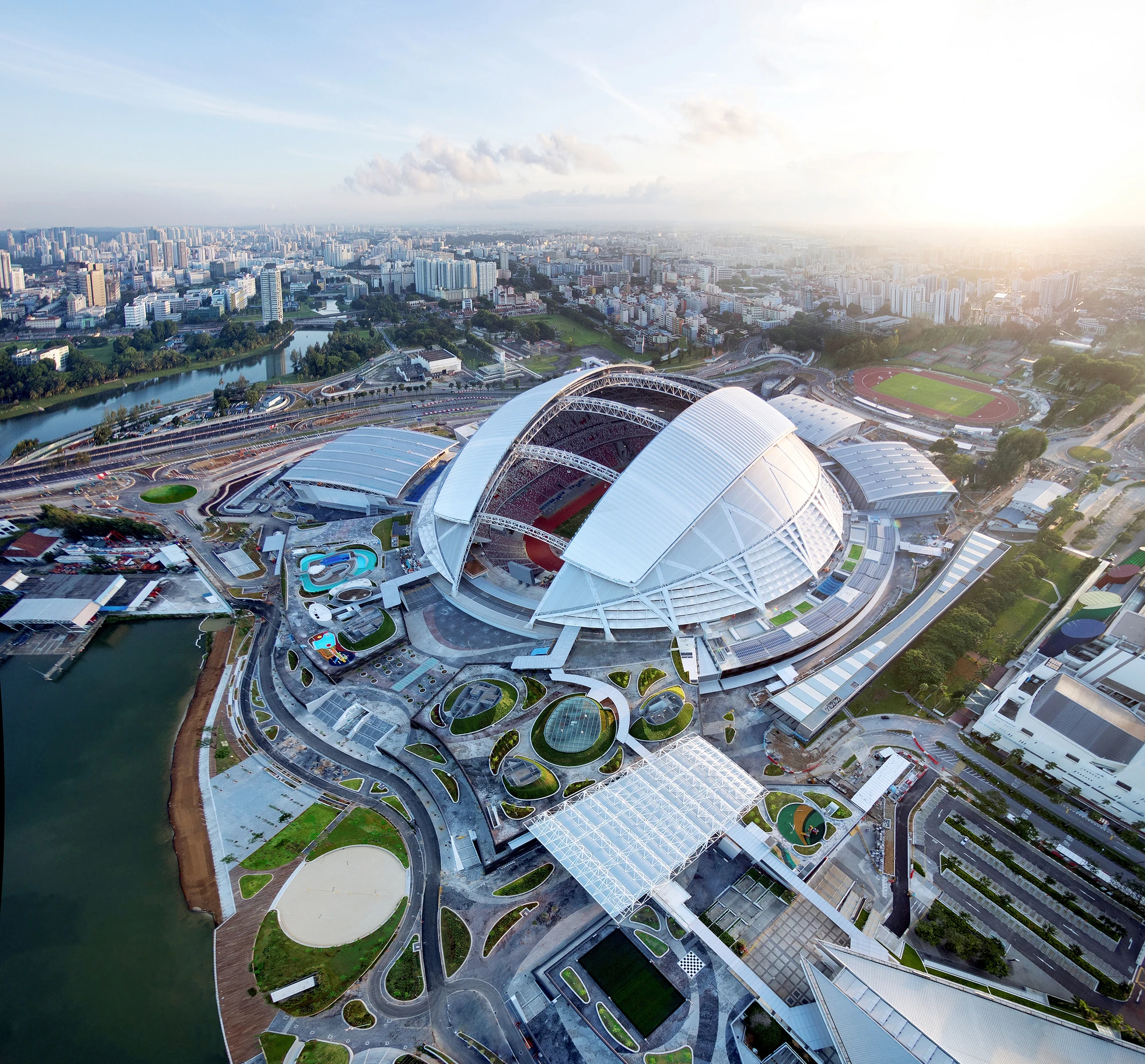
Singapore National Stadium
Complex venues combine event seating, hospitality, public concourses, food service and extensive restroom infrastructure. Plumbing systems serving this type of facility should be evaluated as coordinated networks rather than isolated fixture groups.
Flow-rate compliance remains essential, but service access, standardization and commissioning are equally important for maintaining performance over the life of the facility.
Stadium Architecture SourceLow-Flow Performance Depends on Spout and Basin Geometry
Lower flow does not eliminate the need for precise physical coordination. Spout projection, outlet angle, mounting height, bowl depth, drain location and backsplash clearance affect how the stream reaches the user’s hands. A correctly designed 0.5 GPM installation should place the stream within the usable washing zone without striking the basin wall or causing unnecessary counter splash.
Architects and plumbing engineers should therefore review faucet and lavatory drawings together. This is especially important when a project uses custom stone counters, integral trough basins or long multi-user lavatories where a repeated dimensional error may affect every fixture in the room.
Major Stadiums Illustrating High-Traffic Infrastructure Scale
These stadium photographs provide direct visual context for the type of public-assembly environments in which restroom throughput, water distribution, fixture reliability and maintenance access become major MEP design considerations.
Lumen Field — Seattle
Large urban stadium with concentrated event occupancy and extensive public-support infrastructure.
View Image Source
Caesars Superdome — New Orleans
Enclosed stadium typology illustrating the scale of major public event infrastructure.
View Image Source
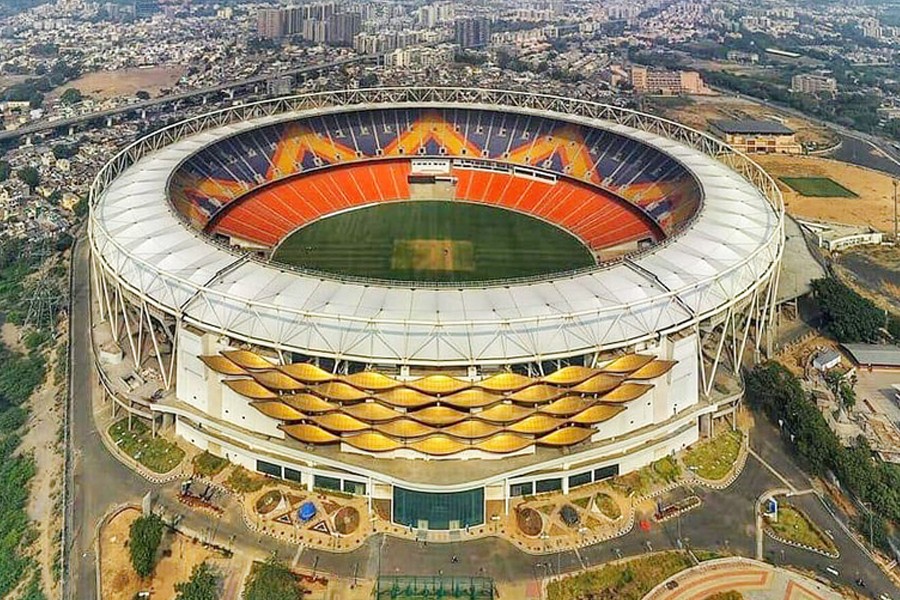
Narendra Modi Stadium — Ahmedabad
Very large stadium environment where restroom capacity and high-volume plumbing performance are critical.
Related Stadium Source
Singapore National Stadium
Major multi-use sports complex illustrating integrated architectural and building-services planning.
View Architecture Source
Rose Bowl — Pasadena
Large open-air bowl stadium demonstrating the physical scale of high-occupancy public venue planning.
View Image Source
BMO Stadium — Los Angeles
Contemporary soccer and entertainment venue used here as a reference for modern public-assembly infrastructure.
View Architecture Reference
Wrigley Field — Chicago
Historic urban ballpark illustrating how stadium infrastructure is integrated into a dense surrounding context.
View Stadium Reference
Rungrado 1st of May Stadium — Pyongyang
Major stadium typology included as a scale reference for extremely large public-event facilities.
View ArchDaily Source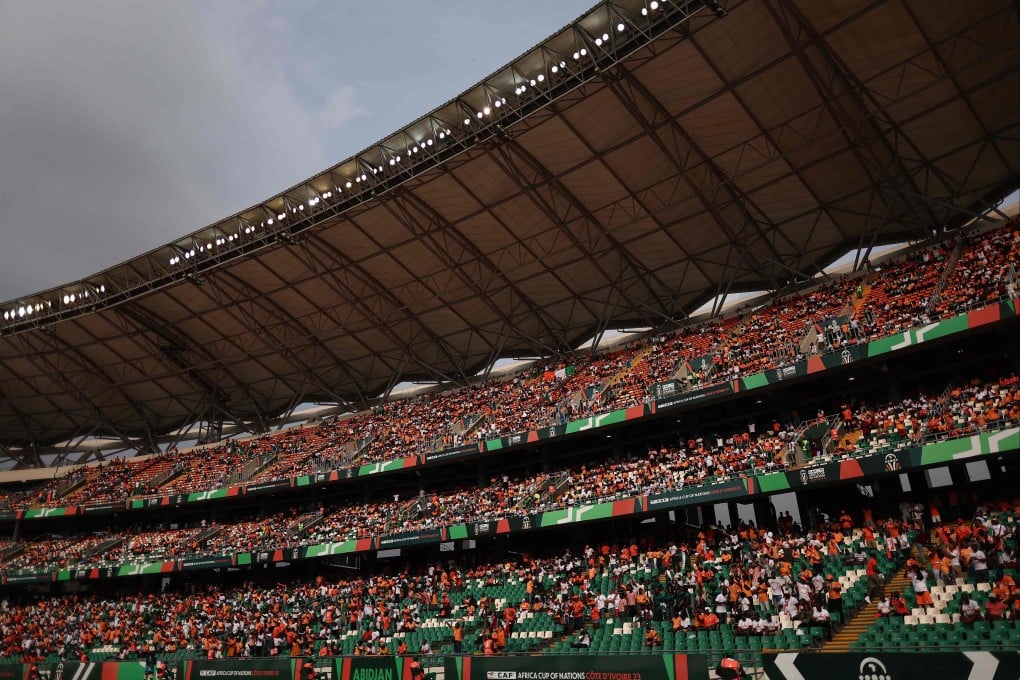
Alassane Ouattara Olympic Stadium
Large African football venue demonstrating concentrated event occupancy and the support infrastructure required for major matches.
View Image Source
Large Stadium Infrastructure — Philippines
Regional large-venue reference illustrating spectator capacity, circulation and public-support requirements.
View Image SourceFlow Compliance Does Not Replace Accessible Lavatory Design
Automatic operation can reduce the physical effort needed to activate a faucet, but accessibility remains a complete lavatory-design issue. Clear floor space, knee and toe clearance, counter height, reach, exposed piping and adjacent accessories must all be coordinated.
Sensor position also deserves review. Users approaching from different positions should be able to enter the detection zone reliably without unusual hand movement.
AEC specifications should therefore avoid implying that a sensor faucet by itself makes an installation accessible. Compliance depends on the complete installed assembly and applicable accessibility provisions.
The same distinction applies to water efficiency: an automatic faucet may improve operational control, but the exact submitted outlet still determines the maximum water delivery rate.
Flow Rate Is Only One Part of Commercial Faucet Approval
Commercial faucet review may also include compliance with the applicable plumbing supply fitting standard, drinking-water-contact material requirements, lead-content restrictions, temperature-control requirements, electrical requirements and project-specific sustainability criteria.
These requirements answer different engineering questions. A fixture can deliver the correct GPM but still require additional documentation before approval. Conversely, certification to a product standard does not remove the need to confirm the project’s required flow-control configuration.

Review the Exact Faucet, Outlet and Control Package
A commercial faucet family may be available in multiple finishes, outlet configurations or power arrangements. The engineer should therefore evaluate the exact submitted model rather than relying solely on a general collection description.
Submittal information should identify the faucet, aerator or flow-control insert, operating-pressure range, sensor control, automatic shutoff, power source and below-counter components.
Commercial Fixture Models for AEC Evaluation
The following product assets were extracted from the supplied Fontana image list. Square image frames preserve the complete fixture profile and make the group easier to review during specification coordination.

FS1104BG
Brushed Gold Touchless Faucet

FS2070BG
Brushed Gold Commercial Touchless Faucet

FS2070-MB
Matte Black Touchless Faucet

FS2071-C
Chrome Touchless Commercial Faucet

FS2071-MB
Matte Black Touchless Faucet

FS2202
Commercial Touchless Faucet

FS2204BG
Brushed Gold Touchless Faucet
FS2214
Commercial Touchless Faucet

FS2228
Commercial Touchless Faucet

FS2361TF-ORB
Oil Rubbed Bronze Touchless Faucet

FS7036MB
Matte Black Touchless Faucet

FS7046ATB
Antique Brass Touchless Faucet
What the Plumbing Engineer Should Require Before Approval
The most effective way to avoid flow-rate problems during construction is to define the required information before bidding. Product-family marketing sheets should not replace model-specific documentation when different aerators, sensors or power options are available.
- Exact manufacturer and model number.
- Maximum flow rate in GPM and L/min.
- Reference pressure associated with the stated flow.
- Exact aerator or flow-control device.
- Applicable plumbing fitting certification.
- Potable-water-contact documentation where required.
- Operating pressure range.
- Sensor detection range.
- Automatic shutoff or timeout information.
- AC, DC, battery or hybrid power configuration.
- Supply connection requirements.
- Temperature-control or mixing arrangement.
- Solenoid and controller access requirements.
- Filter and strainer service access.
- Spout reach and basin coordination.
- Approved replacement aerator part number.
Maintenance Must Preserve the Approved Flow-Control Configuration
A faucet may begin operation with the correct outlet and later drift away from design intent if maintenance staff replace the aerator with an incompatible component. This risk increases when several unrelated fixture families are installed within one facility.
Standardization can simplify spare-parts inventories and help facility teams retain the specified flow rate over time. Maintenance documentation should identify the approved aerator, solenoid, sensor, filter, controller and power components so replacements can be made without changing the fixture’s operating characteristics.
For stadiums and entertainment venues, serviceability is particularly important because restroom availability can directly affect queues and guest circulation during a major event. Components should be accessible without destructive removal of counters, wall finishes or permanent millwork wherever practicable.
Practical Flow-Rate Approval Sequence for AEC Teams
Classify
Determine public versus private use and identify whether the submitted fitting operates as a metering or nonmetering faucet.
Verify Code
Confirm the adopted plumbing, accessibility and sustainability requirements for the project’s actual jurisdiction.
Set Flow
State the required maximum flow in the plumbing fixture schedule and specification.
Lock the Outlet
Identify the exact aerator or flow-control insert necessary to achieve the approved condition.
Coordinate
Review pressure, basin geometry, sensor range, power and service access as part of a single fixture assembly.
Commission
Confirm sensing, shutoff, stream quality and installed flow-control components before final acceptance.
Stadium, Theater and Architectural Faucet Project Context
Las Vegas MLB Stadium
Large-venue touchless fixture context for high-volume public restroom planning and infrastructure coordination.
Fontana Touchless Faucets for the New Las Vegas MLB StadiumMemorial Stadium
Commercial chrome touchless fixture reference for stadium restroom applications.
Fontana Chrome Touchless Faucets for Memorial StadiumVirginia Architectural Faucets
Architectural project context for public lavatory fixture selection and commercial design coordination.
Virginia Architectural FaucetsHershey Theater
Entertainment-venue reference where public restroom reliability and maintenance requirements intersect.
Hershey Theater PennsylvaniaRegulatory Compliance and Strong User Experience Can Be Designed Together
Commercial restroom flow-rate compliance should not be approached as a simple exercise in restricting water. The engineering objective is to provide the required maximum flow through a fixture that maintains a stable, usable stream under real operating conditions.
Touchless operation can support that strategy because the system controls both when water begins flowing and when it stops. The flow-control device establishes the maximum delivery rate, while the sensing system influences operating duration. Together, those elements affect consumption and user experience.
Stadiums and similar public venues magnify the consequences of small specification decisions. A minor difference in aerator flow, sensor shutoff delay or maintenance practice can be repeated across many fixtures and thousands of activations. AEC teams should therefore establish clear fixture requirements during design rather than relying on field adjustments after installation.
The most defensible specification identifies the applicable code, determines the faucet classification, states the required flow, establishes the approved outlet, requires model-specific documentation, coordinates the basin and water system, and provides a commissioning process. This approach allows compliant touchless fixtures to support regulatory approval while maintaining operational performance in demanding commercial environments.